Safe eclipse viewing starts before you reach the viewing site. You’ll need solar viewers from a vetted manufacturer, separate filters for cameras or binoculars, and a clear plan for supervising children. This guide explains what to buy, how to check it, when eye protection must stay on, and what to do during totality. It also covers New Zealand’s 2028 total solar eclipse, winter travel conditions, viewing-site safety and symptoms that need prompt medical attention. The key rule is firm: during every partial phase, never look directly at the sun without proper solar protection.

Summary
The quick answer: how to view a solar eclipse safely
Use eclipse glasses or a handheld solar viewer that has been shown to meet the ISO 12312-2 international safety standard. Buy directly from a manufacturer vetted by the American Astronomical Society, or from an authorised reseller named by that manufacturer.
Ordinary sunglasses, smoked glass, exposed film, X-ray film and homemade filters aren’t safe. A label claiming that glasses are “ISO certified” isn’t proof either. ISO sets the standard but doesn’t test or approve individual products.
Keep proper solar viewers over your eyes throughout every partial phase. This applies even if cloud, haze or sunset makes the sun look less bright.
Essential eclipse safety rules
| Situation | Safe approach |
|---|---|
| Partial or annular eclipse | Use a safe solar viewer whenever looking directly at the sun |
| Partial phases before and after totality | Keep solar viewers on |
| Brief total phase | Direct viewing is safe only while the Sun’s bright face is completely covered |
| Cameras, binoculars and telescopes | Fit a purpose-made solar filter securely over the front of the optics |
| Children | Use close adult supervision or an indirect viewing method |
| Damaged or uncertain viewers | Don’t use them |
| No eclipse glasses available | Watch a projected image with your back to the sun |
Which New Zealand eclipse are you preparing for?
Neither of the two solar eclipses in 2027 will be visible from New Zealand. The next major event for travellers is the total solar eclipse on Saturday 22 July 2028.
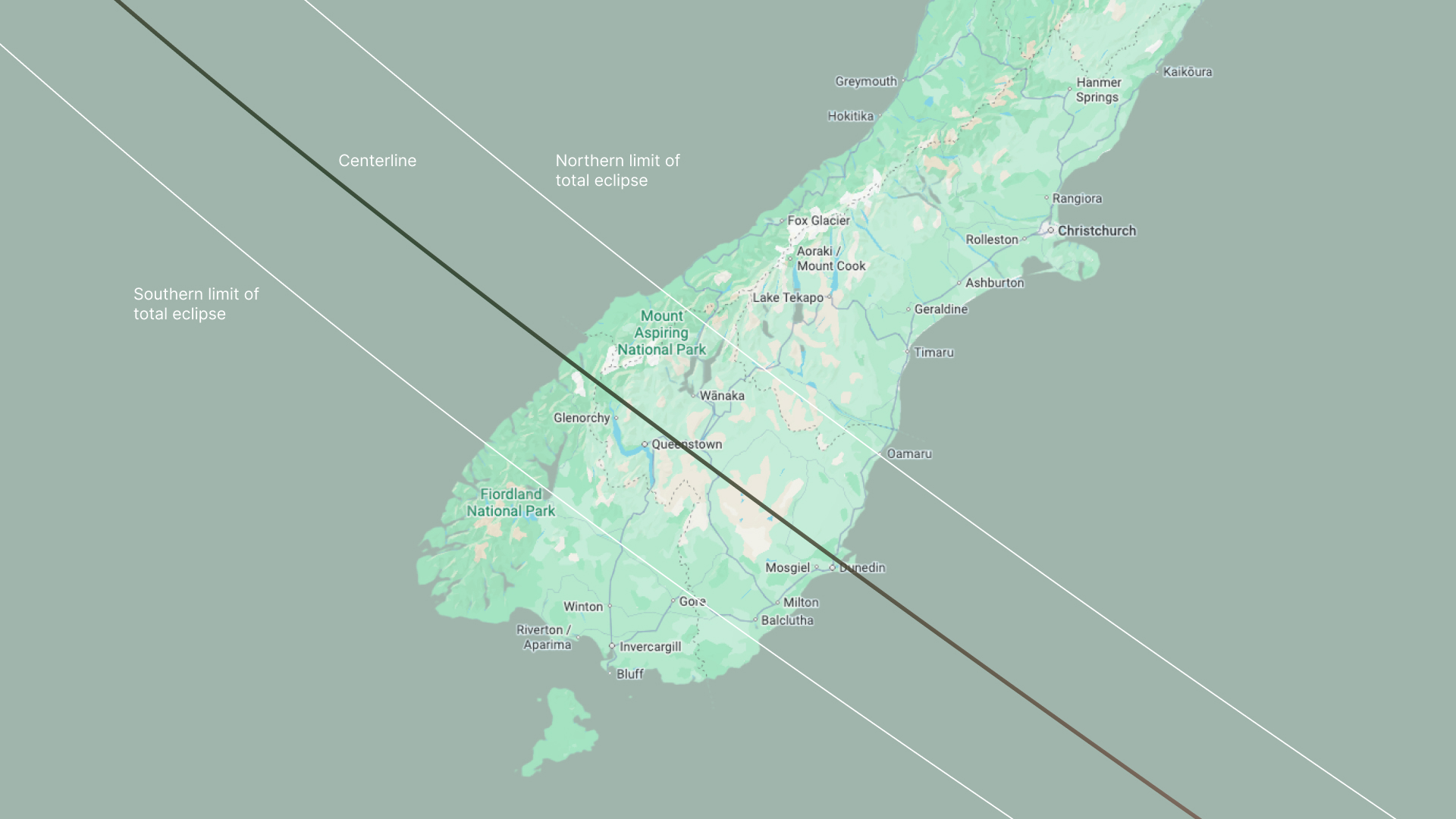
Totality will cross parts of the lower South Island. Current calculations place Dunedin, Queenstown and parts of inland Otago inside the path.
Start with our Solar Eclipse 2028 New Zealand tours hub for suitable itineraries and trip-planning support. Our detailed 2028 New Zealand solar eclipse guide covers the path, viewing bases and South Island route options.
Approximate 2028 eclipse timings
| Location | Partial eclipse begins | Totality | Approximate totality duration |
|---|---|---|---|
| Dunedin | 3:09 pm NZST | Around 4:17 pm | About 2 minutes 50 seconds |
| Queenstown | 3:07 pm NZST | Around 4:16 pm | About 2 minutes 54 seconds |
These are approximate calculations for each city. Obtain timings for your exact viewing location closer to the event, particularly if you plan to watch near an edge of the totality path.
The date and broad eclipse path are well established, but detailed local contact times and the precise edges of the path may be refined as better lunar-limb calculations become available. Mountains and valleys along the Moon’s edge can shift calculated path limits by roughly 1 to 3 kilometres and change contact times by several seconds. NASA’s 22 July 2028 eclipse map and methodology provides the current technical reference.
How to choose safe eclipse glasses
Look for solar viewers that meet the requirements of ISO 12312-2, the standard for direct observation of the Sun. The safest buying process is:
- Check the American Astronomical Society’s current supplier list.
- Buy from a listed manufacturer or an authorised reseller identified on the manufacturer’s website.
- Read the printed instructions before eclipse day.
- Check that the solar film is firmly attached to its frame.
- Discard viewers with scratches, punctures, tears, loose film or damaged frames.
Marketplace listings deserve caution. Counterfeit products can carry copied manufacturer names and false standards claims. Buy early enough to confirm the source, but check the official supplier list again before travelling because guidance and product availability can change.
When you put safe viewers on indoors, you shouldn’t be able to see furniture, windows or normal household lighting. That dark appearance is expected. Don’t use this as your only authenticity test, since it can’t confirm protection from invisible ultraviolet and infrared radiation.
How to put eclipse glasses on correctly
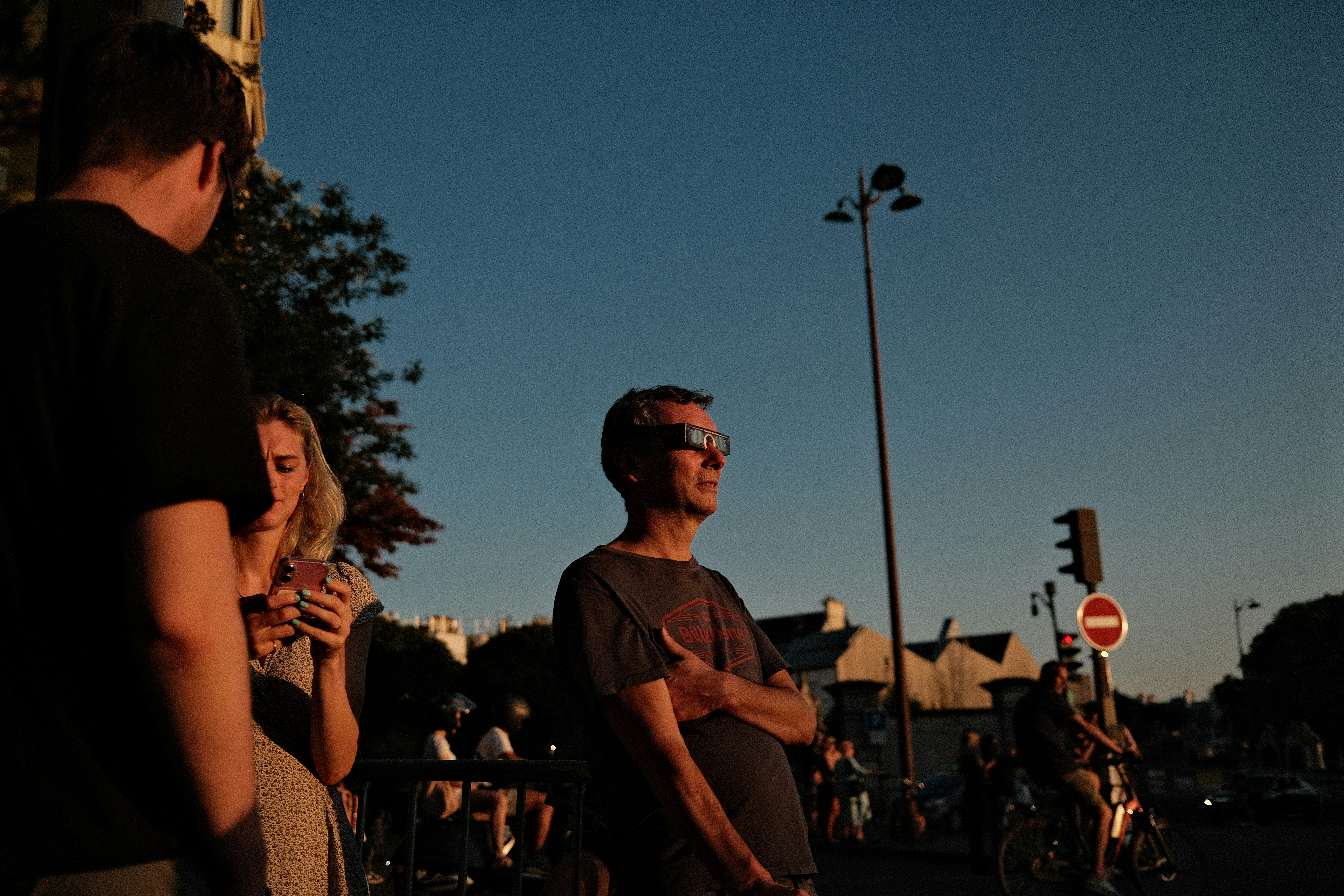
Stand still and face away from the sun. Place the glasses securely over your eyes before looking up. If you wear prescription glasses, keep them on and place the eclipse glasses over them.
After viewing, turn away from the sun before removing the glasses. This small routine matters in a busy viewing area, particularly when people are moving, talking or trying to take photographs.
Sample 2028 solar eclipse itineraries


Eye safety during partial phases and totality
It is never safe to look directly at a partial eclipse with unprotected eyes. This remains true when the sun is almost covered, sitting low on the horizon or shining through thin cloud.
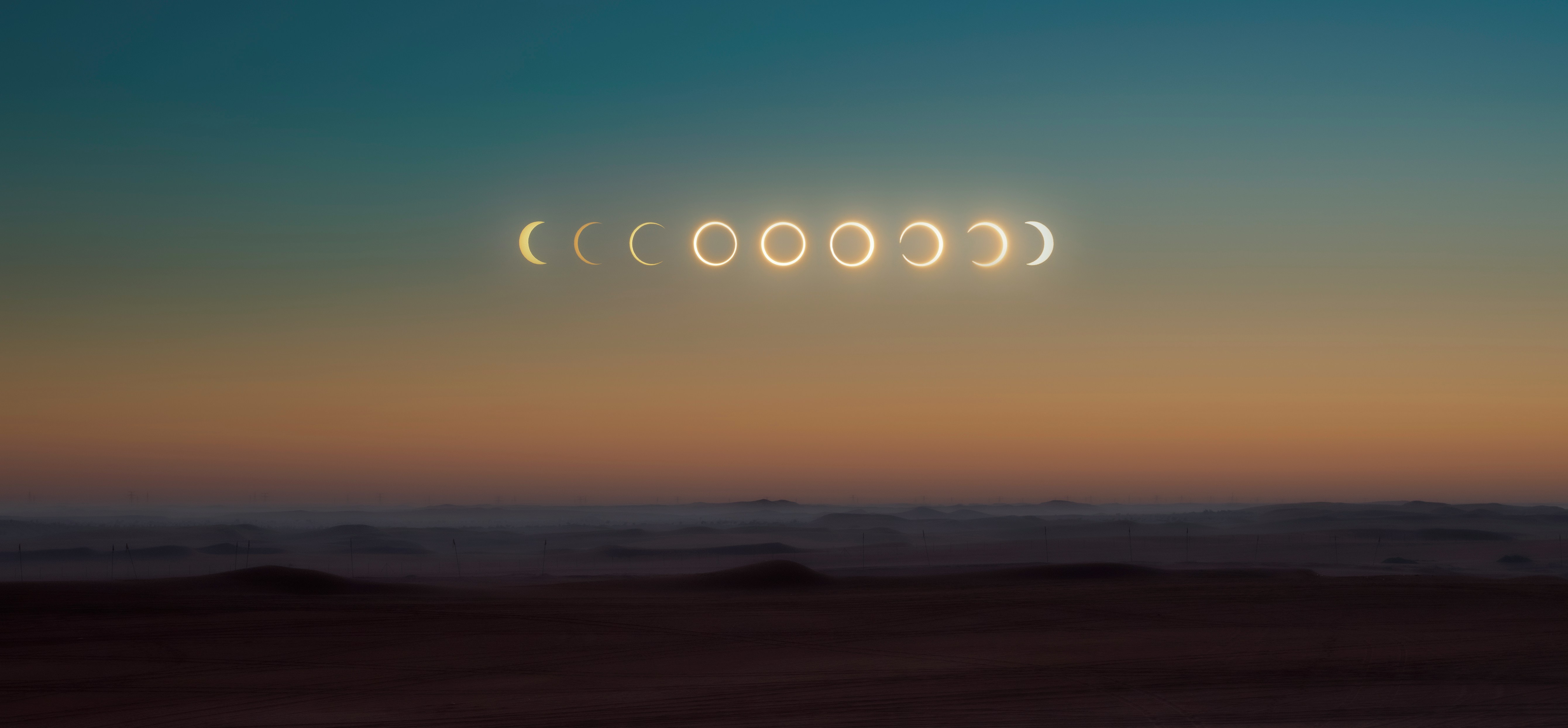
During a total solar eclipse, viewers inside the path of totality may look without solar glasses only while the Moon completely covers the sun’s bright face. Keep your viewers on through the partial phase. Remove them only after totality has clearly begun, then replace them as soon as the first bright point of sun returns. NASA’s eclipse-viewing safety guidance explains the distinction between the partial phases and complete totality.
If you’re outside the path of totality, the eclipse remains partial and eye protection stays on whenever you look directly at the sun. If you aren’t confident about your position or the timing, keep your viewers on and follow instructions from a qualified event organiser or astronomer.
A safer plan for children
Children need active supervision rather than a verbal reminder. Practise with the glasses indoors so each child knows how to hold them in place.
On eclipse day:
- Assign one adult to each young child where possible.
- Use child-sized viewers, where available.
- Make sure the solar-filter material completely covers both eyes whenever the child faces the sun.
- Put the viewer in place before the child looks up.
- Ask the child to turn away before removing it.
- Keep binoculars and cameras out of reach.
- Use a pinhole projector if the child won’t keep the viewer in place.
- Let an adult control any removal and replacement of glasses during totality.
For a school or family group, an indirect projection station is easier to supervise than dozens of children looking up at once.
Can you use cameras, phones, binoculars or telescopes?
Eclipse glasses protect your eyes during unmagnified viewing. They don’t make it safe to look through an unfiltered camera, telescope or pair of binoculars.
Magnifying optics concentrate sunlight. That concentrated light can damage equipment, destroy a handheld viewer and injure an eye very quickly.
Cameras and phones
A camera needs a purpose-made solar filter fitted securely over the front of the lens during every partial phase. The filter must suit the lens and come from a reputable specialist supplier. ISO 12312-2 applies to direct-viewing products, not to filters for magnified optics.
Before eclipse day:
- Ask an experienced solar photographer or astronomy specialist to check your setup.
- Practise fitting and removing the filter without pointing the camera at the Sun, and follow the filter manufacturer’s testing instructions.
- Cover or remove any optical viewfinder.
- Use the rear screen rather than placing your eye against the camera.
- Set the focus, exposure and tripod position in advance.
- Use a remote shutter so you can watch the event safely.
- Practise the full filter-removal sequence if you plan to photograph totality.
Don’t hold eclipse glasses over a phone or camera lens as a substitute for a fitted solar filter. Don’t improvise with neutral-density filters, stacked sunglasses or photographic film.
A filtered camera protects the equipment and allows it to record the partial eclipse safely. It doesn’t protect anyone looking directly at the sun beside or over the device. Continue using eclipse glasses whenever you look away from the screen towards the sun during a partial phase.
Binoculars and telescopes
Binoculars and telescopes need solar filters secured over each front aperture, where sunlight first enters the instrument. Filters that attach near the eyepiece are dangerous because concentrated sunlight can destroy them.
Any finderscope must also be removed, capped or safely filtered. Public viewing equipment should be managed by an experienced operator who remains beside it throughout the event.
Indirect viewing without eclipse glasses
A pinhole projector lets you watch the changing shape of the sun without looking at it.
Make a small hole in a piece of card, stand with your back to the sun and allow the light to fall onto another pale surface. The projected image will show the sun becoming a crescent during the partial phase.
Never look through the pinhole. It is a projector, not a viewing lens. The gaps between leaves or the holes in a colander can create the same crescent projections on the ground.
Plan a safe New Zealand viewing site
For the 2028 eclipse, the viewing location matters beyond the path of totality. Maximum eclipse occurs late on a South Island winter afternoon, when the sun will be low and temperatures can fall quickly.
Choose a site with:
- A clear view towards the low afternoon sun
- Legal, organised parking
- Enough space to keep people away from moving vehicles
- Firm ground that won’t become slippery in frost or rain
- Shelter from cold wind
- Toilets and accessible paths where required
- Mobile coverage or an agreed meeting point
- Permission from the landowner
Don’t stop on road shoulders or enter paddocks without permission. Avoid clifftops, narrow coastal pull-offs and icy roadside viewpoints, even if the horizon looks better there.
Weather, roads and route pacing
Cloud is the main uncertainty in any eclipse trip. Build the itinerary around a worthwhile base.
I’d allow at least three nights in Dunedin: one for arrival, one for the city or Otago Peninsula, and one for eclipse day. Arriving several days early gives you room for delayed flights and winter road conditions.
Don’t plan a last-minute drive from Dunedin to Queenstown because one forecast looks clearer. The trip takes about four hours in good conditions, and winter weather, frost, road closures or eclipse traffic can stretch that time. Driving while watching cloud movement is a serious distraction.
A well-paced South Island road trip can continue from Dunedin to Queenstown, then through Aoraki Mount Cook National Park and Lake Tekapo. Give the Mackenzie region two nights if stargazing matters, since one clear winter night is never assured.
Book the fixed parts first once your travel dates are firm: accommodation in the path, rental transport and any organised viewing event. Queenstown is already busy during the July ski season, while Dunedin, Aoraki Mount Cook and Lake Tekapo have more limited accommodation than large international cities. Discover New Zealand’s 2028 eclipse tours and planning hub is the place to compare suitable routes.
“We had a great time during our tour in the beautiful New Zealand. All aspects of the tour from initial planing to trip logistics were well arranged with zero glitch. A few times we had minor questions about the specifics of the tour. All were answered within the hour through the trip App.”

Speak to a New Zealand travel specialist
Planning a trip to New Zealand? Speak to one of our Wānaka-based travel specialists and get local advice on where to go, when to travel and how to make your itinerary work.
EnquireWhat to pack for safe eclipse viewing
Keep the safety equipment in your hand luggage rather than checked baggage. Pack:
- Two safe solar viewers per person, stored flat in protective envelopes
- Purpose-made solar filters for any camera or optical equipment
- Printed eclipse timings for your exact location
- Warm layers, gloves and a weatherproof jacket
- Shoes with grip for wet or frosty ground
- A torch for returning to the vehicle after the light fades
- Sunscreen and a hat for the long partial phase
- A pinhole projector as a backup
- A power bank for phones and cameras
- Any regular prescription glasses
Check every viewer again on eclipse morning. A spare is useful if one is dropped, creased or damaged.
What to do if your vision changes afterwards
Solar retinal injury can be painless, and symptoms may develop gradually over several hours or days. Warning signs include blurred or distorted central vision, a blind spot, colour changes or unusual light sensitivity, according to the US National Eye Institute.
If you notice any of these symptoms after looking at the sun, contact an optometrist, ophthalmologist or urgent-care service promptly. Don’t drive if your vision is affected. Call 111 if the situation is an immediate or life-threatening emergency.
Check safety guidance again before travelling
The date and broad path won’t change, but local contact times, path-edge calculations and viewing-event arrangements may be updated. Recheck the latest guidance from the American Astronomical Society, NASA, New Zealand health authorities and your event organiser before departure.
The best eclipse plan is quite ordinary on paper: vetted viewers, tested equipment, warm clothing, a legal viewing site and enough time to avoid a rushed drive. Get those details settled early, then use the main Solar Eclipse 2028 New Zealand hub to shape the holiday around Dunedin, Queenstown and the dark skies of the Otago region.
Solar Eclipse Eye Safety Questions
These answers cover the safety questions travellers commonly ask before watching a partial or total solar eclipse in New Zealand.
No. Ordinary sunglasses, including very dark or polarised lenses, don’t provide enough protection for direct solar viewing. Use a solar viewer from a vetted manufacturer that meets ISO 12312-2 requirements.
Not during the brief period when the sun’s bright face is completely covered, provided you’re inside the confirmed path of totality. Glasses must stay on before totality and go back on immediately when any bright sunlight reappears.
Yes, but the phone lens needs a suitable front-mounted solar filter during every partial phase. Don’t use handheld eclipse glasses as a camera filter, and keep wearing eclipse glasses whenever you look directly towards the sun.
Yes, when the viewers come from a vetted source and are used under close adult supervision. Use child-sized viewers where possible and make sure the solar-filter material covers both eyes whenever the child faces the sun.
Stop looking at the sun. If you notice any change in your vision, even several hours or days later, seek prompt assessment from an eye-care professional. Don’t drive if your vision is affected.